Castleton Hall
This is a summary, in date order, of the information contained within the Victoria History of the County of Lancaster. It was published in 1906 and consists of eight volumes describing the inhabitants of the county, drawn from documentary evidence. References are to Volume 4 of the History of Lancashire unless otherwise stated. Also and the History of Rochdale the historical text shared a comprehensive view of the hall as a significant stone-built gentry seat characterized by its wealth of heraldic decoration and extensive agricultural and functional outbuildings.
Castleton Hall was a significant stone-built gentry seat, and while a family took their name from the township as early as the 12th century, they remained for only a brief period. By 1332, a Nicholas de Castleton was recorded as paying a subsidy there, but the name disappears from rolls by 1380, leaving the area until the Holt family settled there early in the 16th century. In 1523, Adam Holt, described as a "gentleman of ye Castleton," settled his lands on his sons William, Thomas, Richard, and Rauf, while specifically reserving a dower for his wife, Agnes. Following the dissolution of the monasteries, Robert Holt of Stubley obtained a large portion of the estate from Henry VIII, and by 1555, he was recorded as having died seised of the "manor of Castleton". The hall served as a primary residence for successive generations, including Thomas Holt in 1566 and Charles Holt shortly thereafter, before Charles's son, John Holt of Stubley, moved there toward the end of his life, eventually dying at the hall in 1622.
Castleton Hall was built around the reign of Elizabeth I and is an irregularly shaped two‑storey stone building with the front facing east. In 1626 it was described as “a fair mansion house, being built with freestone” with adjoining stables, ox house, dove house, gardens, orchards, and courts (Fishwick, Rochdale in the Beginning of the 17th Century). Its location was strategically positioned near the "high street to Manchester" and adjacent to Castleton Moor,. The grounds were defined by natural boundaries, with a line running to the "Sudden behind Castleton Hall," continuing down the stream to the river Roch. The south wing was pulled down in 1719.
Francis Holt constructed Castleton Hall in 1515. The hall had beautiful gardens with a stream running in front of it and thickly wooded grounds. Henry VIII sold the Castleton estate in 1542 to Robert Holt of Stubley, after which it became the family’s chief residence. James Holt and his widow were the last Holts at Castleton in 1713. The Entwistle family inherited the house from Dorothy Holt, daughter of Robert Holt, who married into the Entwistle family in 1649.


The Main Staircase
The great hall (26 ft long and 17 ft 3 in wide) formed part of the main entrance to the house. Some of the walls were oak‑panelled, and in the upper lights of one of the windows were the arms of the Holts of Gristlehurst and Robert Holt of Castleton, along with other shields showing their alliances. The upper rooms were accessed from the back of the hall via a small oak staircase with twisted balusters and carved newals were added in the 18th century. The staircase is a fine example of early 18th‑century Renaissance detail, with open twisted balusters and massive square carved newels. Orginially the main entrance was complete with extensive oak wainscotting and a wide staircase with carved balustrades The windows of the hall were a visual record of family alliances, filled with 16th and 17th-century heraldic glass. One window displayed the arms of the Talbots of Salesburie, the Stanleys (encircled by a Garter), and the Townleys, while the lower portion featured the arms of Hopwood of Hopwood and the Chetham griffin. Another window contained the shields of Seyvell of Tankersley, Holt of Grizzlehurst, Atherton of Atherton, and Robert Holt of Castleton himself, alongside the Asshetons of Middleton and Traffords of Trafford. Despite later rebuildings, the house retained ancient elements such as a massive open fireplace in the kitchen that predated the 18th century.
One of the owners, Robert Holt, was a magistrate, deputy lieutenant for the county, and High Sheriff between 1634 and 1640. He dated his official reports on ship-money directly from Castleton. In 1642, he was recommended by Lord Strange to have charge of the "powder and match" magazines.His support for the King led to his discharge from the commission of the peace in 1642 and an eventual fine of £150 to compound for his estates in 1646. Upon his death in 1673, he left his "armour and pistoles" and a "greatest piece of gold" to his eldest son, Thomas. Thomas Holt (eldest son) died without issue in 1676, and the estate passed to his brother, James Holt. The male line of the Holts at Castleton ended with James Holt, a fellow of Brasenose College and and served as a JP in 1691, who died in 1712 in York, leaving his daughters,Frances, Elizabeth, Isabella, and Mary, settlements of £1,500 each. His widow, Dorothy, who founded Holt’s Charity to educate poor girls, lived at the hall until her death in 1718. Her will reveals the family maintained a second residence in York, directing that her "coach and horses" and other York-based goods be sold.
The house was demolished in 1919.


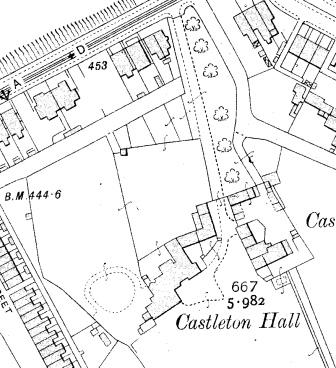
Map of Castleton Hall, taken from Lancashire sheet LXXXVIII 8, Edition of 1910