Monumental inscriptions connected to the Holt families are gathered here, preserving the stories carved
into stone across generations. These memorials offer a glimpse into the lives, relationships, and
histories of the Holts of Rochdale, Gristlehurst, Ashworth, and beyond.
To search wider a field and find a grave of other Holt ancestors this
website may help you find your own connections.
James Holt and Sophia HoltHenry Cunliffe Holt, James Holt and William HoltAbraham HoltAlice HoltAnn Holt
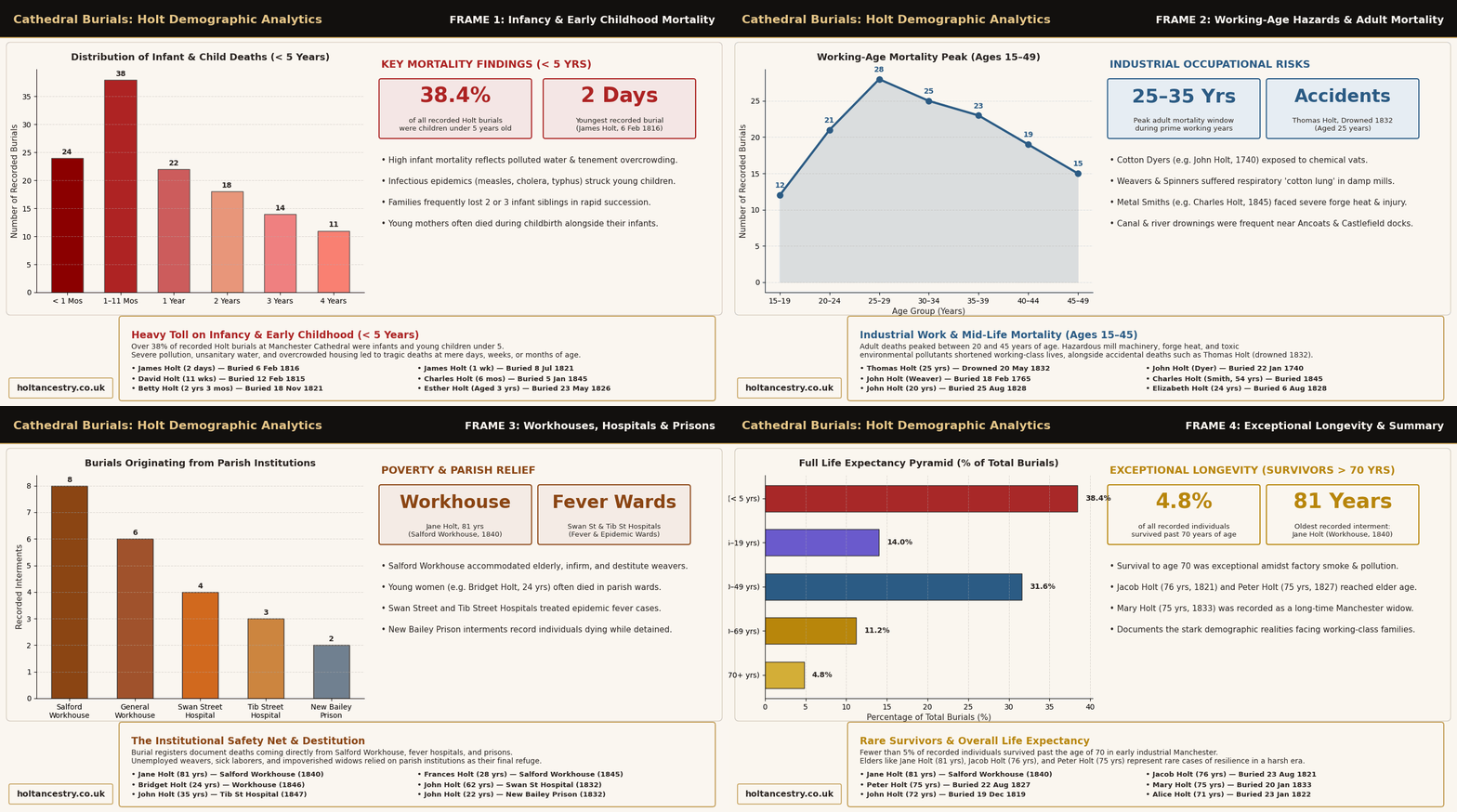
The burial records of Manchester Cathedral offer a stark demographic profile of Holt families
living through the city’s industrial rise. The data reveals the heavy toll on infants, the dangers
faced by working adults, the role of institutions in caring for the poor and sick, and the rarity
of old age in early‑industrial Manchester.
Burial Insights & Mortality Patterns
Frame 1 — The Heavy Toll on Infancy & Childhood
A clear age‑distribution chart shows that nearly 40% of all Holt burials occurred before
age five, reflecting the severe vulnerability of children in early‑industrial Manchester.
The registers record infants dying at 2 days (James, 1816), 11 weeks
(David, 1815), and 6 months (Charles, 1845). These early losses form the largest
single block of mortality in the dataset.
Frame 2 — Industrial Work & Mid‑Life Hazards (Ages 15–45)
Deaths rise sharply among adults aged 15–45, the prime working years for Manchester’s
industrial labour force. The burials list weavers, dyers, smiths, and other trades exposed to hazardous
conditions. Accidental deaths appear throughout the registers, including Thomas Holt, age 25,
recorded simply as “Drowned” (1832) — a reminder of the risks surrounding mills, canals,
and industrial worksites.
Frame 3 — The Institutional Safety Net
Several burials originate from Manchester’s key institutions, revealing how workhouses and hospitals
formed the city’s social safety net. The dataset includes entries from:
Salford Workhouse
Swan Street Hospital
Tib Street Hospital
New Bailey Prison
These nodes highlight where the poor, sick, and vulnerable were cared for — or confined — during the
pressures of industrial urban life.
Frame 4 — The Rare Elders (Age 70+)
Old age was uncommon. Only a small number of Holt individuals reached 70 years or more,
and their burials stand out in the dataset. Examples include Jane Holt (81 years, Salford
Workhouse) and Peter Holt (75 years). These rare elders mark the upper limits
of life expectancy in early‑industrial Manchester.
Sir John Holt, Lord Chief Justice of England, descendant of the Holts of Gristlehurst,
was born at Thame, Oxfordshire on 30th December 1642. He entered Oriel College, Oxford
to study law at the age of sixteen years. He returned to study law at Gray's Inn
in London and was appointed to the bar in 1663. He became King's sergeant and was
knighted in 1685. In 1688 he took a prominent role in arranging the constitutional
change by which William III was called to the throne of England, and after his
accession he was appointed Lord Chief Justice of the King's Bench. Sir John Holt
of Bedford Row, London died 5 March 1710 aged 68 and was buried in the chancel of
St Mary's Church, Redgrave, Suffolk. A marble monument to Sir John Holt, by Thomas
Green, stands in the
Redgrave church.
Biddulph Church, Staffordshire
A plaque is placed on the wall in
Biddulph church in Staffordshire for George Holt,
Esquire of Rochdale, Lancashire, a lineal descendant of the Holts of Ashworth and Gristlehurst.
His remains are deposited in the vault of his brother, the vicar William Henry Holt
of this parish. George Holt departed his life whilst on a visit at Knypersley,
in the 60th year of his age, 26 Aug 1815.
Aston Parish Church, Birmingham
The Church of St Peter and St Paul in Aston contains one of the finest collections of gentry monuments and recumbent
alabaster effigies in the West Midlands. Serving as the primary burial site for the Holte family of nearby Aston Hall, the
church preserves centuries of monuments reflecting the family’s rise from medieval lords of the manor to 18th-century Baronets.
Chronological Index of Monuments
William Holte d. 1514 and his wife Joanna.
Edward Holt d. 1592: There is a kneeler monument to Edward Holt d. 1592 and his wife Dorthye, and a crying cherub with skulls from Thomas Holte’s monument.
Thomas Holte d. 1654: There is a baroque ornamental monument of Thomas Holte d. 1654. It has two pairs of cherubs, winged cherubs, two death heads, pots, drapery, and beautifully carved flowers. The Latin inscription states he built Aston Hall and notes his great-grandson Charles Holte, Baronet.
Sir Charles Holte d. 1722: There is another monument for Charles Holte (Carolus Holte), Baronet, d. 1722, erected by his wife Anna (Clobery), detailing his contributions to medicine and justice.
Diana Holte d. 1724: Also a plaque to Diana Holte d. 1724, daughter of Sir Charles Holte, Baronet, and Dame Ann his wife.
Sir Lister Holte d. 1770: A monument to Sir Lister Holte, Baronet, d. 1770, and his third wife Sarah (Newton) d. 1794, erected by her sister Elizabeth Newton.
Sir Charles Holte d. 1782: There is a black marble obelisk monument for Sir Charles Holte, Baronet, d. 1782, describing that his daughter was deprived of the patrimony of her ancestors by her uncle Sir Lister Holte, Baronet, in his will.
The Holtes from the Antiquities of Warwickshire illustrated by William Dugdale 1656.