The Chartist Movement and the Holt Families of Lancashire (1838-1857)
The Chartist movement in the United Kingdom lasted roughly from 1838 to 1857, with its strongest periods of activity
occurring in 1839, 1842, and 1848. It began with the launch of the People's Charter in 1838, which outlined six key political
reforms. The movement saw major petitions and mass meetings during these years, with significant strikes and uprisings,
such as the 1842 General Strike and the 1848 Kennington Common rally. Despite its efforts, the movement was eventually
suppressed by government authorities by the late 1850s.
Chartism was one of the most significant working class political movements of the nineteenth century, and Manchester
stood at its centre. For families like the Holts—artisans, spinners, small manufacturers, and politically aware
tradesmen—the movement represented both a call for democratic rights and a response to the harsh economic realities of
industrial Lancashire. This page brings together a concise history of Chartism in Manchester and a curated list of Holt
individuals known to have participated in, supported, or been recorded in connection with the movement.
The Chartist Movement: A Brief History
- Chartism emerged in the late 1830s as a national campaign for political reform.
- Its name derives from the People’s Charter of 1838, which demanded six key reforms:
- Universal male suffrage
- Secret ballots
- No property qualification for MPs
- Payment for MPs
- Equal electoral districts
- Annual parliaments
- Manchester’s rapid industrialisation created a large, politically conscious working class.
- The city was a hub for radical newspapers, mass meetings, and trade‑based activism.
-
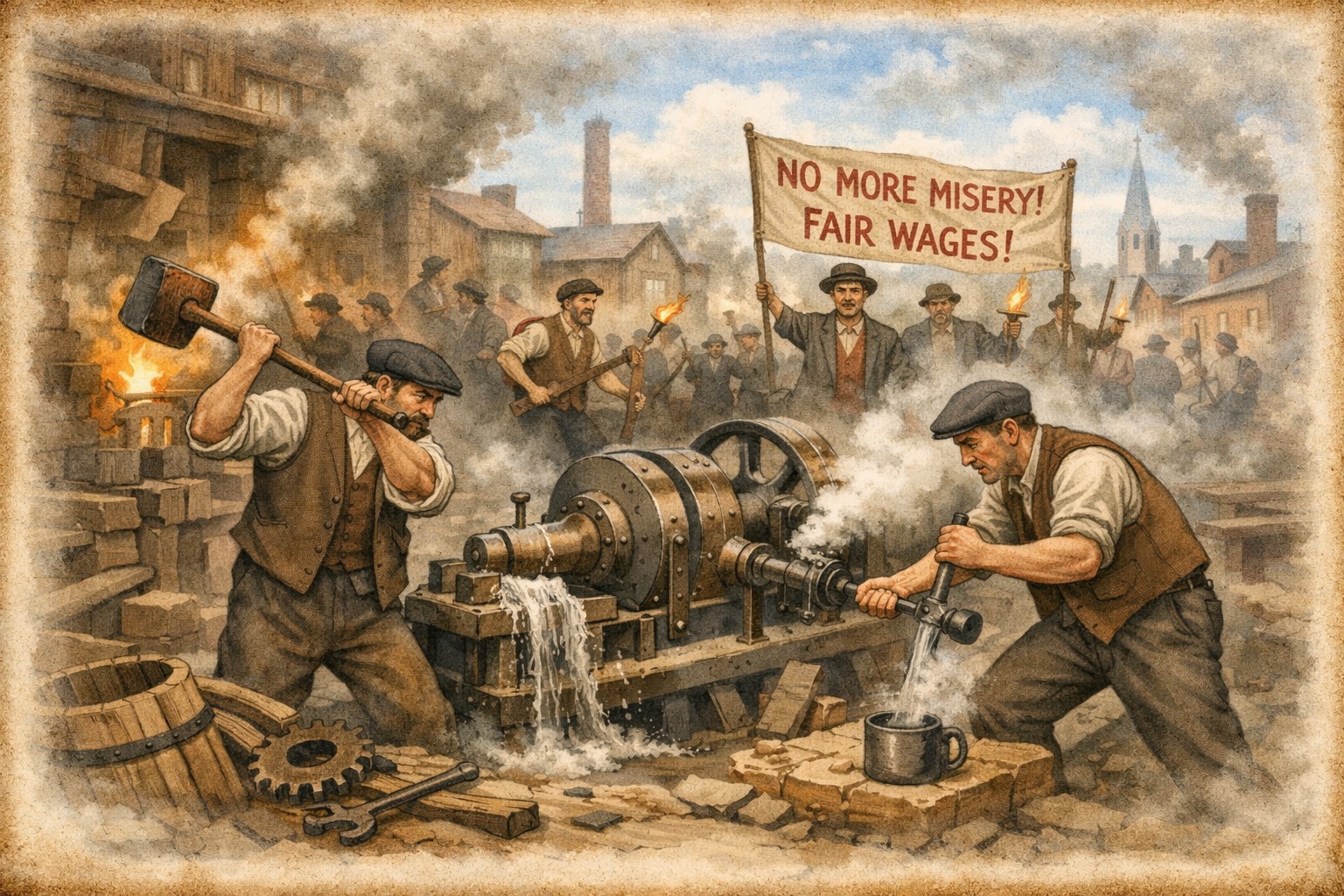 The 1842 General Strike, widely known as the Plug Plot Riots, marked one of the most intense moments of
industrial and political unrest in Victorian Lancashire, with Manchester at its centre. Triggered by deep wage
cuts, soaring food prices, and a severe economic downturn, the strike quickly merged with the anger that followed
Parliament’s rejection of the Chartist Petition earlier that year. As discontent spread, thousands of workers moved
from mill to mill across Manchester, Salford, Oldham, Rochdale, Bolton, and the wider cotton districts, pulling the
plugs from steam‑engine boilers to bring factory machinery to a halt—an act that was both symbolic and devastatingly
effective. In Manchester, the movement took on a distinctly political character: mass meetings on St. Peter’s Fields revived
memories of Peterloo, and speakers linked the immediate struggle for wages with the broader Chartist demand for democratic
reform. The government, fearing a coordinated uprising, deployed troops and special constables throughout the region, leading
to hundreds of arrests and trials. Although the strike collapsed under military pressure and economic necessity, it became
the first mass political strike in British history, revealing how tightly intertwined labour grievances and political reform
had become in the industrial North, and cementing Lancashire’s reputation as a crucible of working‑class radicalism.
The 1842 General Strike, widely known as the Plug Plot Riots, marked one of the most intense moments of
industrial and political unrest in Victorian Lancashire, with Manchester at its centre. Triggered by deep wage
cuts, soaring food prices, and a severe economic downturn, the strike quickly merged with the anger that followed
Parliament’s rejection of the Chartist Petition earlier that year. As discontent spread, thousands of workers moved
from mill to mill across Manchester, Salford, Oldham, Rochdale, Bolton, and the wider cotton districts, pulling the
plugs from steam‑engine boilers to bring factory machinery to a halt—an act that was both symbolic and devastatingly
effective. In Manchester, the movement took on a distinctly political character: mass meetings on St. Peter’s Fields revived
memories of Peterloo, and speakers linked the immediate struggle for wages with the broader Chartist demand for democratic
reform. The government, fearing a coordinated uprising, deployed troops and special constables throughout the region, leading
to hundreds of arrests and trials. Although the strike collapsed under military pressure and economic necessity, it became
the first mass political strike in British history, revealing how tightly intertwined labour grievances and political reform
had become in the industrial North, and cementing Lancashire’s reputation as a crucible of working‑class radicalism.
Holts Connected with Chartism in Lancashire
This section lists Holt individuals identified in contemporary newspapers, trade directories, and Chartist reports in the from Chartist Ancestors Databank. It is not exhaustive but reflects currently traceable evidence.
| John | Holt | Not given | Bury |
| Edmund | Holt | Not given | Todmorden |
| John | Holt | Not given | Todmorden |
| J | Holt | Not given | Oldham |
| Thomas | Holt | Overlooker | Ashton-Under-Lyne |
| James | Holt | Labourer | Bacup |
| James | Holt | Grocer | Bacup |
| Richard | Holt | Warper | Bacup |
| James | Holt | Grocer | Bacup |
| Richard | Holt | Warper | Bacup |
| James | Holt | Labourer | Bacup |
| James | Holt | Grocer | Bacup |
| Richard | Holt | Warper | Bacup |
| Adam | Holt | Joiner | Bolton |
| John | Holt | Weaver | Bolton |
| James | Holt | Weaver | Bolton |
| William | Holt | Weaver | Bolton |
| Isaac | Holt Sen | Weaver | Bolton |
| Isaac | Holt Jr | Weaver | Bolton |
| Ellen | Holt | Weaver | Bolton |
| James | Holt | Engineer | Bury |
| Daniel | Holt | Beamer | Bury |
| Mary | Holt | No trade | Bury |
| Richard | Holt | Cordwainer | Bury |
| Edwin | Holt | Labourer | Rochdale |
| William | Holt Sr | Dyer | Rochdale |
| William | Holt Jr | Loom tackler | Rochdale |
| Richard | Holt | Woollen carder | Rochdale |
| Thomas | Holt | Woollen spinner | Rochdale |
| James | Holt | Woollen rover | Rochdale |
| Thomas | Holt | Labourer | Rochdale |
| Samuel | Holt | Printer | Rochdale |
| William | Holt | Printer | Rochdale |
| James | Holt | Weaver | Rochdale |
| Edmund | Holt | Shopkeeper | Rochdale |
| Thomas | Holt | Deviler | Rochdale |
| J | Holt | Not given | Manchester |
| Elizabeth | Holt | Minor | Lancashire |
| Mary | Holt | No trade | Lancashire |
| Ellen | Holt | Weaver | Lancashire |
| Sarah | Holt | Weaver | Lancashire |
| Henry Cunliffe | Holt | Spindle Maker | Manchester |
Source Note
Extract from Chartist Ancestors Databank. A valuable resource for exploring the Chartist movement. (Source: the summary cannot be used for commercial purposes.)
Chartism in Manchester was a defining moment in the political awakening of industrial Britain. Henry Cunliffe Holt, a spindle maker, is documented in several contemporary newspapers documenting his attendance at Chartist events, including the Manchester Courier and Lancashire General Advertiser (20 August 1842), the British Statesman, the Morning Herald (17 August 1842), and the English Chronicle (18 August 1842).